Artifacts Reference
As exposed in the Main Concepts, Artifacts are the corner stone in Microcks as they hold valuable information on how your API or microservices are expected to work. One of Microcks's beauties is that it uses standard specifications or standard tooling files as Artifacts, allowing you to reuse existing assets. Microcks will use constraints and examples from them to build its knowledge base.
Microcks supports the following specifications and tooling file formats as artifacts:
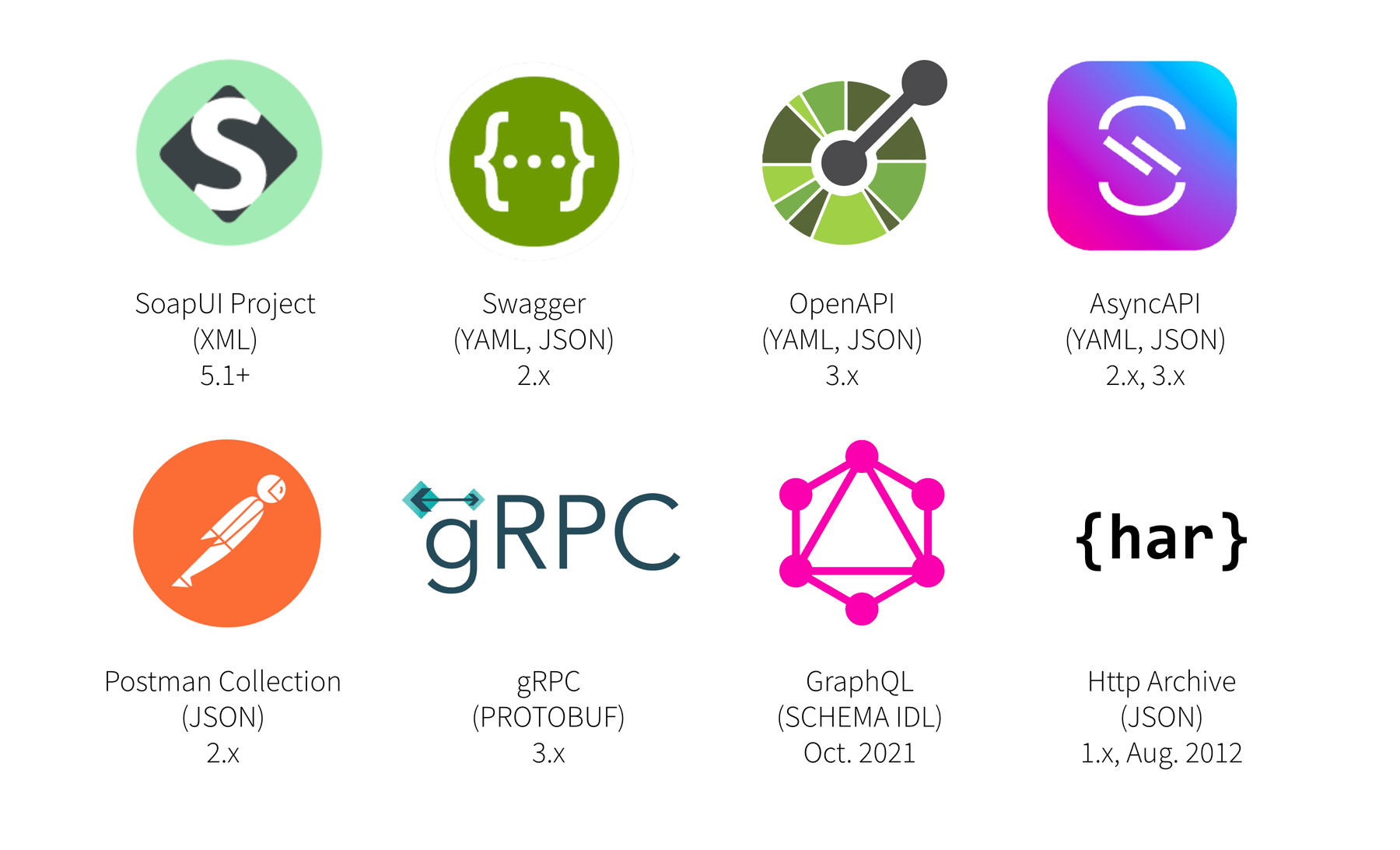
We provide built-in parsers and importers for the following formats:
- SoapUI projects files starting with version 5.1 of SoapUI,
- Swagger v2 files,
- OpenAPI v3.x files in either YAML or JSON format,
- AsyncAPI v2.x and AsyncAPI v3.x files in either YAML or JSON format,
- Postman collections files with v2.x file format,
- gRPC / Protocol buffers v3
.protofiles, - GraphQL Schema
.graphqlfiles, - HTTP Archive Format (HAR) JSON files,
Microcks may require those artifact files to follow some conventions in order to collect the valuable information it need. This documentation is a reference of those different conventions for the above mentioned formats:
OpenAPI Conventions
How OpenAPI example names link params, requests and responses into mocks and tests.
AsyncAPI Conventions
How AsyncAPI v2/v3 message examples, headers and bindings drive async mocks and tests.
Swagger Conventions
Mock Swagger v2 APIs by pairing them with a secondary artifact holding the examples.
GraphQL Conventions
Pair a GraphQL schema with examples and pick dispatchers for queries and mutations.
gRPC Conventions
Pair a .proto file with examples and define dispatch rules for gRPC methods.
Postman Conventions
Structure a Postman collection (examples, test scripts) so Microcks can mock and test it.
SoapUI Conventions
Structure a SoapUI project (requests, responses, XPath or Groovy dispatch) for Microcks.
Http Archive Conventions
Import recorded HTTP Archive (HAR) traffic as a primary or secondary artifact.